The September 11, 2001, terrorist attack on the World Trade Center inspired me to write a short story about that event (I’d started churning out fiction as a Serious Author during the late Nineties) and to post that congeries of letters and punctuation marks not long afterward onto my now-defunct website, Pixel Stupor, on that now-defunct server, Yahoo! GeoCities. Now, to commemorate the attack’s twenty-fifth anniversary, I’ve dredged up that story, which contains sexually-explicit content (no fooling—as the characters starts getting busy, we don’t pan over to a crackling fireplace) and a narrator whose gender politics (not to mention his taste in DVDs) I definitely do not share. So, if you think you can handle an R-rated story (with a gargantuan R festooned in blinking lights) written by a callow thirty-five-year-old (who would turn a mature thirty-six two months and one day after the attack), then please click here.
During my second date with Miranda, at an Asian fusion restaurant called Bamboo Circle (multiculturalism rules!), I decide to tell her My Mom Story. I tend not to reveal anything too personal about myself so soon when I start dating someone, but I’ve already grown serious about Miranda—very serious. She’s the hottest woman I’ve ever met on my favorite singles site, BrainyDate.com: hypnotic brown eyes, plump crimson lips, tawny skin, thick black hair cascading halfway down her back, and a trim figure with a sloping, porn-quality rear. Her empathy also appeals to me, for she works as an assistant director for The Initiative, a charitable organization that covers tuition and travel and other expenses for Third-Worlders (many of them female) who want to study business (with a Western free-market emphasis) at America’s finest schools; the students often return home after graduating to put what they’ve learned into practice, either teaching others or starting companies or both. As she told me during our first date, at Guessed Room Coffee, she’d had her “pick of a million higher-paying jobs” after graduating with her MBA five years ago from that prestigious private university in the tonier part of town, but she’d wanted “to make a difference, as corny as that sounds, by helping improve the minds—and the economic conditions—in developing countries.” Plus probably because The Initiative’s founders, a couple of Silicon Valley billionaires, had “made sizable donations to Trump’s second inaugural committee, ha ha,” his administration, which usually doesn’t have a very high opinion of immigrants (to say the least), hasn’t objected to the ones these founders have helped bring to our country—well, hasn’t objected so far, “knock wood,” two words Miranda says as she raps on her forehead a few times.
Anyway, the Mom Story.
My mother phoned me one evening to say she had some very special news, and she wanted me to be the first to know. She said she’d met someone: a guy named Colin at Sir Reads-a-Lot, the local used bookstore where she bought her gardening books. (She’d always had a vast library of them, though I’d never seen anything grow at our house over the years other than the size of her false eyelashes, which now extended an inch or two in front of her face. I don’t think I’ve ever seen her actual eyelashes.) She said she’d fallen in love with him at first sight; in fact, she’d immediately known for sure he was the love of her life. (When I was sixteen, my parents divorced after fifteen years of marriage due to that all-purpose reason, irreconcilable differences.) She’d been involved with him for about a month, and she wanted me to meet him, so a few days later, the three of us had dinner at a place she’d suggested, the Bulging Platter, my favorite restaurant as a child; my family had seemed at its happiest whenever it dined there. I myself still went there occasionally; it still looked the same, with those Southwestern-style, adobe-colored interior walls that had reminded the much-younger me of camels, even after I’d learned that camels didn’t live in the Southwest. We even sat at my family’s favorite booth, next to the giant plastic fern in the red plastic vase.
Colin was fifty-nine, the same age as my mother. He had a craggy face and short, graying blonde hair. He had biceps that strained against the sleeves of his green polo shirt. He used to teach electrical engineering at the local college, till he took an early retirement four years earlier. He now spent his time writing, having self-published two books about his former field—books aimed, as he put it, “at a target audience who doesn’t know a thing about electrical-related matters, except for how to change a lightbulb without too much difficulty, maybe just occasionally burning down a couple blocks in the process.”
I thought he was smart, funny, and friendly. I liked him a lot. Plus I could tell he loved my mother in return, for he kept rubbing her hand on the table with great care while staring at her as protectively as she did with him.
Half an hour later, during our entrees, he mentioned that he felt comfortable enough with me to bring up something he usually didn’t talk about with strangers. Something “not exactly uncontroversial,” but he thought I had “enough brains to take it without swooning backwards onto the old fainting couch.” He had almost finished writing his “latest and greatest book”: “a revisionist historical study” called Give or TakeSixMillion, about the Holocaust.
Uh-oh.
I asked what he meant by “revisionist.” He replied that the book, “using newly-discovered evidence,” would “examine whether or not a so-called Nazi genocide against the Jews had actually occurred.” Sure, he didn’t deny the Nazis had killed some Jews, maybe a couple hundred, “still a serious number,” but, based on that newly-discovered evidence he’d spoken of, and based of the findings of others “in the revisionist community”—well, in his “humble opinion,” it seemed “pretty unlikely the Nazis had singled out that particular religion for, you know, special treatment at such an extreme level.” He wanted to communicate this argument, again, to an audience who didn’t know a thing about the topic at hand. An audience who didn’t know “about the absence of legitimate German documents related to an alleged Holocaust.” An audience who’d never heard “about the lack of Zyklon-B residue on the walls of the alleged gas chambers at Auschwitz.” An audience whose ignorance had resulted from Holocaust movies, particularly Schindler’s List by the director Steven Spielberg, “one guess as to what his religion is.”
I didn’t guess.
“Look, I have nothing against the Jews, nor do I have a particular interest in National Socialism,” Colin said. “But I do have an interest in the truth. You should know the truth about the past, no matter your race or religion. After all, the past influences everything that follows it. Sorry if I still sound like a college instructor.”
No one said anything for a moment.
“And by the way,” Colin continued, “though I’m obviously not a fan of Schindler’s List, I do give three thumbs up to the Spielberg movie that preceded it, a little something you might have heard of called Jurassic Park. Those dinosaurs look so real.”
“Yes, they do,” my mother said.
I asked her if she agreed with Colin’s views about the Holocaust, and she said absolutely, she’d read his book and agreed with every word; she’d always had “this nagging feeling that the Holocaust was a little improbable, anyway, what with all those logistics and stuff.”
Yeah, the Germans aren’t known for caring about logistics and stuff, I retorted.
She thought I should hold off on judging him till I actually read his book. She thought Colin wrote very well, in “nontechnical language, with no academic jargon.” His book would cause “open-minded Jews to reexamine their beliefs.” When I was growing up, I’d never heard her say anything anti-Semitic, because I’d never heard her say anything at all related to any ethnic group (though I had heard her occasionally tsk-tsk the inner-city blacks she’d seen on the TV news, but I guess almost everyone tsk-tsked them back then).
I told my mother as calmly as possible that I loved her, but that she was fucking crazy, and that Colin was fucking crazier, and that she shouldn’t contact me at all, at all, until after she’d come to her senses about the Holocaust and dumped that Nazi asshole to the curb, where garbage belongs. That was the first time I’d ever used profanities in front of her. If what I’d said had made her angry, she gave no indication of it, instead smiling a faint smile as I got up from our booth.
“Going to the synagogue?” Colin asked with a chuckle.
Suppressing the urge to smash his face in, I walked out of the restaurant.
That was twelve years ago. I haven’t contacted her since or vice-versa. But last month, I thought, well, maybe I should contact her again. Maybe she has come to her senses but hasn’t told me about it for whatever reason. Hey, you never know. So I tried calling her, but her number had gone out of service. I e-mailed her, asking how she was doing. No response. I got in touch with her friends, the few of them I could find, but they couldn’t help me out, either. I drove to her house, the house I’d grown up in, and saw it no longer existed, nothing left but a grassy, weedy patch of land. I looked her up on the Internet but found nothing—no social-media posts, no address, no phone number, no obituary. Nothing about Colin, either, or any of his books, including the Holocaust one, if he ever published that. Maybe she’d married him, so I went to the courthouse, to look through the marriage records and, might as well, the death records, too. Zilch on all accounts. Finally, as a very, very last resort, I texted my father to see if he had any information about her. He texted back “Your mom? The last I heard, she was sucking cocks in hell,” followed by a laughing-slash-crying devil face emoji. I had the feeling my old man would respond like that (it had been a pretty nasty divorce, plus he’d never had much of a filter), but I wanted to pursue all my options. Sometimes I’m a little too thorough for my own good.
The end.
I look at Miranda.
“Um, congratulations on your perseverance?” she says.
Thank you.
“I hope I didn’t sound sarcastic.”
No, not at all.
“Good. But—I just don’t understand why you bothered trying to contact her in the first place.”
Well, she is my mother.
“Sure, of course, she’s your mother, but you made the right decision by cutting her out of your life. You seem to be obsessing over her, something that—”
I don’t mean to express any anti-immigrant sentiment, but I start thinking that maybe Miranda can empathize with people from countries thousands of miles away, but she has no interest in a Yank like me who wants to reestablish control over his life. Who doesn’t want to know where his mother and his possible stepfather are, even if they are Holocaust deniers? Maybe Miranda has no control over her own life, maybe by choice; she could masochistically enjoy being a pawn. Or maybe she carts around her own gargantuan familial baggage and doesn’t need to cart around mine. Whatever the case, I know she’s started pulling away from me, that I’ve bummed her out, but why should someone not get bummed out every once in a while? We don’t live in a fantasyland.
I tell Miranda that I agree with her, that I need to quit obsessing about my mother, et cetera, et cetera. “Glad to hear that,” Miranda says in a sweet voice. Later that night, we have sex at my place (the same event that had happened during our first date), but I know she’s just about finished pulling away, for she grinds against me even louder and more vigorously than she did last time. Lying under her on my bed, I doubt she’s faking her orgasm, for she seems too guileless for that type of performance, judging from the non-carnal experiences we’ve shared together. She must want to end our involvement with a bang, pun intended; an intense sexual experience makes a great going-away present.
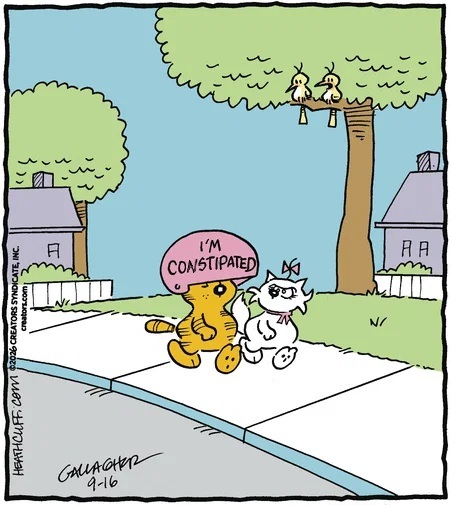
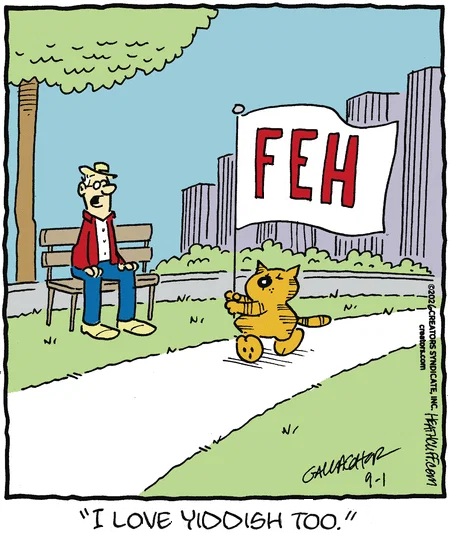
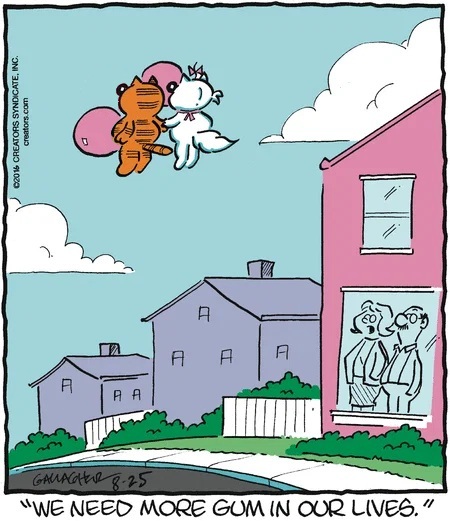
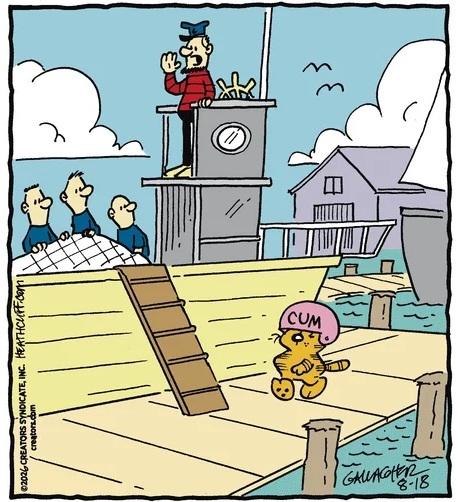
“I prefer spelling it C-O-M-E, but we all have our linguistic preferences, I guess.”
“Yes, Heathcliff likes organic cat food. And he likes sudoku puzzles. And he likes long walks on the beach. But he really likes anything related to jizz, skeet, spunk, splooge, love custard, baby batter, man milk, penis paste, however you wanna phrase it. Again, linguistic preferences. The English language is ever-changing.”
“Today is no-fap Tuesday. Let’s beat the hell out of him, then stare longingly at that poster of Pete Hegseth.”
“I had planned on killing myself today, but after seeing that cat walking around wearing that helmet, I realized life is fantastic, filled with so many pleasant surprises. Choose life, me mateys. Choose life.”
I found the following student essay on a computer screen at the Community College of Beaver County’s library on April 15, 2002. Except for omitting the author’s name, I now present the essay verbatim.
■
Hamlet: Streetwise
Francicso downed his last drink in an attempt to keep wake. He and Bernardo worked as security guards at club Alcatraz. The two often worked one after the other. Tonight Bernardo was working graveyard shift.
Bernardo arrived wearing his dull blue slacks with the matching hat and button up shirt. On his waist sat his belt which held his gun, a bottle of mace, and a nightstick.
As Francisco clocked out, a red Mercedes Benz pulled up at the front door. It was Horatio and Marcellus. They had come to inquire about a ghost. Horatio wore a blue suede suit with leather blue pants and a suede sweater. To set it all off, he wore a white pimp hat with a blue feather in it. Marcellus had the latest fashion of designer Jordans. To go with the shoes he wore a Jordan mesh jump suit with zip up pants. To set off this collectors gear, he wore a Kangol hat and 100% diamond earrings made in Denmark.
Francisco finally leaves. The three then pull up chairs in the boom boom room to discuss matters about the ghost most recently seen. While conversing, the ghost of Hamlet’s father appears. Horatio and Marcellus try to get it to speak some words to them. The ghost seems to take offense to their words and will not answer them. But just when it seems ghost will speak, the dawning of a new day, and the sun arises. The ghost then disappears.
“Because he’s our boy we should tell Ham what we saw, aiight,” said Horatio. “Aiight,” replied the other two.
Hamlet was the son of the late owner of Alcatraz. Because of his father’s death, his uncle was forced to take ownership. Now the owner has taken Hamlet’s mother for his bride, and he doesn’t like it.
Laertes, son of Polonius, wants to go back to France in order to go to school there. He has to get his blessing from his father in order to go. After the father’s blessing he must get his Godfather’s, who is the owner, blesssing.
Finally, Horatio, Marcellus, and Bernardo found Hamlet. “Ham, what’s up, man,” all together. Hamlet still feels terrible about his father’s death. “Why are yall here?” “For your father’s funeral.” But Hamlet was a lot brighter than that. He told them they were there for his mother’s wedding. “That too.”
But they had to tell him some strange new about what they saw at the club the previous night. “Man, we saw yo daddy, man.” This information was hard, but true upon Hamlet’s ears. “For real”, Hamlet replied. “Yea dawg, he’s a ghost, and we saw him in the Upper Room, of the club,” Horatio responded. “What he say”, asked Hamlet. “Nothin’, he just disappeared,” they all replied.
“Keep a lookout though, cause he might come back tonight,” Horatio demanded. No sooner than Horatio’s response, the ghost appeared. “OH SHOOT,” hollared Hamlet. “Is that my daddy?” “Yea, that’s him,” replied the others as they jumped back suddenly. The three cried, “He’s a scary Motha,” “Shut yo mouth,” replied Hamlet. “Just talkin’ ’bout yo daddy,” they laughed.
The ghost then left the room, in which case, Hamlet followed. Once he and the ghost were alone together, it started to talk. “I was murdered by my brother and your uncle,” muttered the ghost. “He pulled the trigger on me while we was rollin’ down 5th Ave,” he continued. “I’m doomed to walk the night because I didn’t let off the burden of my sins.” The ghost went on, “son, you gotta git him, to avenge my murder.” “Don’t worry pops, his butt is mine,” cried out Hamlet. With that the ghost disappeared.
“Ham, where you at,” hollared the others. “Up here,” Hamlet yelled. “What he say, man,” they questioned. He was a little hesitant in telling them, then replied, “First yall have to sware on my nine millimeter here, that no one gets word about it,” he commanded.
The seventh—and possibly last—excerpt from “Our Putative Couple,” a work in progress. For the first six excerpts, please click (in this order) here and here and here andhere and here and here.
■
Friday night, September 7, 2007:
Cassie doesn’t feel like reading, not that she has anything to read anyway, having donated all her books to the Salvation Army the day before graduating from college a month earlier—now the poors could afford to read, out of masochism or genuine interest or both, nearly-impenetrable highbrow analyses of their favorite lowbrow culture. She doesn’t feel like watching television, either, despite having splurged for expanded basic cable (63 channels, US $49.99 a month, no porn, not even any scrambled porn channels, if those still exist). She feels similarly about the thirty-four DVDs (Digital Video Discs or Digital Versatile Discs) she purchased for eleventy-jillion US bucks for her cultural studies classes, DVDs containing mid-Twentieth Century mainstream movies she herself analyzed, her essays never earning anything less than an A-minus; she would gnash her teeth on the rare occasions she did receive that lowly grade—what a perfectionist, ha ha. (Those DVDs probably should’ve gone to the Salvo, too. When she cleans house, she cleans house.) Surfing the Internet makes her shudder, perhaps due to the riptides and wipeouts that accompany surfing. And perspiring in her submicroscopic, air-conditionerless apartment? No effing way.
So she decides to visit the South Side’s least-hip hipster bar, The Localite, for the first time in weeks, to gawk at the interesting clientele. And, why not, she should dress as interestingly as possible herself. Having recently entered her idea of a retro-Nineties Riot Grrrl phase, she puts on her baggiest T-shirt, the camouflage one she stenciled NO MORE WHITE MAN CULTURE across the front of in large capital letters, in black spray paint. (Have we mentioned she belongs to the white race herself? Yes, we believe we have.) She also wears beige cargo shorts and black combat boots and a black unzipped pleather jacket. Plus she eschews makeup, and she eschews shaving her legs, and she eschews shaving her armpits. But (to add some stereotypical femininity to her look, for that incongruous touch) she does attach a pink barrette to her near-crewcutty, bottle-blonde hair.
At the bar, sitting alone at a table, nursing a glass (US $5.50) of that lower-economic-stratum favorite, Stibben’s®, The Beer for When You Want Just Beer™, she checks out her fellow patrons, who predominantly wear what looks like clothing from previous decades, such as rock music T-shirts, rap music T-shirts, grunge music T-shirts, tie-dyed T-shirts, ballcaps advertising defunct businesses, ballcaps advertising Pittsburgh professional athletic teams from when those teams didn’t suck, pleather jackets, pleather pants, pleather skirts, pleather boots (or anything else pleather—Cassie the vegan doesn’t mind this petroleum-based product), and new-wave dresses (combos of neon shapes and neon squiggles and neon smears and—in the more festive designs—neon confetti). Some of these hipsters may have found the above items at thrift stores, but Cassie has the feeling most of the hipsters shop at vintage boutiques, those establishments that sell old, lower-economic-stratum clothing to rich jerks at rich-jerk prices.
Which doesn’t mean the (presumably) rich jerks here tonight don’t look stylish. Lots of them do. But beyond that? Her Riot Grrrl look would piss off the patriarchy; no one else, however, poses a threat sartorially (or likely politically) to the greedheads and misogynists and warmongers in charge. Even the music—Eighties cheeseball rock, which the hipsters surrounding her enjoy listening to allegedly ironically—wouldn’t perturb the ruling class, which in all likelihood enjoys these tracks sans any irony, actual or feigned, a kewl veneer for PR (public relations) purposes for amoral plunderers.
As she takes a careful sip of her beer, she sees a stranger approaching her. You could call him a generic white guy—28 years old, presumably cisgender (though not too many people used the word “cisgender” in 2007), medium-length brown hair, average height (about 5’9″ [175.26 centimeters]), average build (about 200 pounds [90.71 kilograms]), crisp Hawaiian shirt, Eighties-style designer jeans (if not actually from that decade). She sets her glass down just as he arrives.
“Whoa-ohhhh!” he exclaims, taking a few steps backwards, fluttering his hands around in front of him, “I better call the cops, ’cause you just stole my heart!”
Cassie chortles. “Yeah.”
“Yeeeeah!” he says, pointing at her with both hands, each hand alternatingly poking the air several times.
“You got any other clever pickup lines?”
“Lemme think.” He’s obviously imbibed more than one drop that night; besides the manic gesticulating, he also overenunciates in that hyperactive way some drunks (such as Cassie’s mom’s former boyfriend, the gropey one) do before faceplanting onto the floor. “Ohhh, yeah—I seem to have lost my phone number. Can I have yours?”
“Certainly. You ready?”
“Hold on.”
He removes his cell phone from his back jeans pocket. His finger hovers over the buttons, ready to punch in that important info.
“Ready,” he says.
“Okay. Area code 412.”
“Four, one, two.”
“555.”
“Five five—hey, wait a minute, don’t the fake numbers in movies start with five, five, five?”
“Yup.”
The generic white guy pauses. “Ha ha ha ha ha,” pointing his phone at her, “a rill movie buff!”
“I guess so.”
“I like movies too. If you actually gave me your number, we could—”
Another white guy she’s never seen before—29 years old, presumably cisgender, light-brown mullet, 6’4″ (193.04 centimeters), 230 pounds (104.33 kilograms), biceps bulging out of his black T-shirt, thighs bulging under his non-designer jeans—walks up to her table.
“Hello, Jonathan,” the muscular white guy says, addressing the generic white guy.
“Ohhhhh, hi, Troy, how ya doin’?”
“Fine. And you?”
“Fine.”
“What you up to?”
“Nothin’. Just talkin’ with a lady here.”
“Do you know him, miss?”
“Nope,” Cassie replies. “I just met him.”
“Do you want him to talk to you?”
Cassie doesn’t mind. Inebriated horndogs have always amused her. But that other guy—
“Not really,” she answers.
“Aw, come on!” Jonathan protests. “I thought we had a great conversation going!”
Cassie, shrugging her shoulders: “Ehhh.”
“I think you should stop talking to her,” Troy says.
“Awwww!” Jonathan says.
“Go somewhere else. This venue has plenty of space.”
“Ha ha ha, yeah, ‘venue.’ ”
Troy points at him, then points in the opposite direction.
“All right, all right!” Jonathan says, shoving his cell phone back into his jeans pocket. “If she can’t recognize great conversation, I might as well find someone who can! Someone better-looking!”
“So long,” Troy says, waving goodbye.
Jonathan walks away.
“Uh, thanks,” Cassie says.
“No problem,” Troy says.
“You the new bouncer here?”
“Yeah.”
“I’d heard this venue had hired a new bouncer.”
“Actually, I prefer the term ‘security coordinator,’ but you can call me a bouncer.”
Three-point-seven-second pause.
“I didn’t catch your name,” Troy says.
“Cassie.”
“Cassie?”
“Yup.”
Two-point-one-second pause.
“May I see what you have written on your T-shirt, Cassie?”
Two-point-nine-second pause.
“Sure,” she replies.
She opens her jacket.
“Huh. Didjoo write this yourself?” he asks.
“Yep.”
“Interesting.”
Two-point-six second pause.
“Well, nice meeting you,” Troy says.
■
Twelve minutes and nineteen seconds later, as a man screechingly attempts to convince someone he refers to as “you” to copulate with him (as heard in the white, cisgender male, Massachusettsan rock singer Billy Squier’s 1984 single “Rock Me Tonite,” which peaked at number fifteen on the Billboard Hot 100), Cassie finishes her beer. Should she order another one? Ehhh.
Should she sit in this dump all night? Ehhhhhhh.
As she wends her way through the hipnoid crowd, toward the exit, she wonders if she should visit another South Side bar or three to continue drinking. She could get at least slightly blitzed. That would make her foolhardy enough to embrace, truly, the Riot Grrrl lifestyle (short of actually listening to Riot Grrrl songs) by visiting a tattoo shop and having herself inked for the first time, just one tattoo for starters, though what should—
Something smashes into her right elbow, that joint loudly cracking. She stumbles three steps sideways and two steps backwards and starts feeling pain, a dull throb that within milliseconds escalates into something more unignorable, barging into every nerve throughout her Grrrlish figure. Her right arm now stuck at a forty-five-degree angle, cradled by her left arm, she looks around and sees Troy. He holds a wooden cricket bat in both hands.
“No more white man culture?” he shouts.
“Wait, Troy, I—”
Two white men and a white woman rush toward him as he takes another swing.
■
A week later, her right arm encased from elbow to wrist in a lime-green plaster cast (the doctor let her choose the color), Cassie receives an unexpected package: a 22-ounce (623.69-gram) clear plastic jar of Hatchley Organics® Tri-Color [as in red, white, and black] Gourmet Quinoa: US $14.48, plus US $21.40 for USPS® (United States Postal Service) Express Mail® Second-Day Delivery. After removing the jar, she finds, at the bottom of the packing box, a note written on both sides in longhand with a Mont Descamps® Heirloom® pen, black ink, medium point, on a notepad page, 5″ by 7″ (12.7 centimeters by 17.78 centimeters), white paper, whose obverse (in the lower-right corner, taking up almost one-fourth of the page) features a backgroundless, full-color, head-and-shoulders image (composited from various photographic elements two years earlier on an Apple® PowerBook® G4 17-inch [43.18-centimeter] laptop owned by Tina Kaine, a 35-year-old, white, cisgender, female graphic designer at the notepad’s manufacturer, ZSW Brands, in Dayton, Ohio) of a medium-brown Labrador Retriever, black Ray-Ban®-style sunglasses, red Gentleman Caller®-style dress shirt (with popped collar), grinning straight ahead at—
Cassie,
I chose this stationery to give you a laugh. You can use a laugh, right?
And I chose the accompanying gift to keep you healthy. Yes, I know you can find quinoa in Pittsburgh, but I wanted to give you a genuine Midwestern present.
And I want to say that what happened at that bar last week doesn’t negate a thing about you. I mean you still remain yourself. You still remain a quinoa fan, and a smart and funny and empathetic person.
I love you. I know I don’t say this often enough, but I do. I love you, my only daughter, and I always will.
If you need anything, please let me know. And please get better as quickly as possible.
The sixth excerpt from “Our Putative Couple,” a work in progress. For the first five excerpts, please click (in this order) here and here and here andhere and here.
■
Sitting at the kitchen table after the video call, taking a loud and—in her self-conscious opinion—melodramatically drawn-out sip of her mug of Vibe Valley® brand Calming Herbal Hemp Tea, Lavender Mint Blend, Loose-Leaf (having purchased a 2-ounce [56.699-gram] bag for US $9.95 at her neighborhood’s most rainbow peace-sign festooned dispensary, Root Cause, earlier that day), Cassie squints straight ahead at nothing in particular, something Zane has noticed she tends to do when feeling perturbed, or annoyed, or miffed, or bummed. Or nothing at all.
“Anything wrong?” he asks, standing behind her, pouring himself a mug of tea from the Plessents® brand pyramidal, stainless-steel kettle (US $147.09) he what-the-hellishly ordered from Grand Chef Supplies®, his favorite upper-middle-class consumer porn website, using his own money, not a cent from the joint account he shares with his husband, who, before meeting him, had never owned any kitchenware, regardless of price. Zane’s husband had never cooked at all, instead subsisting upon microwavable, artery-clogging, food-type substances whose packages tended to depict superheroes or anthropomorphic animals or characters from live-action movie adaptions of YA (young adult) fantasy novels.
Cassie takes another, quieter, less melodramatic sip.
“You noticed how frail our bio-dad looked?” she asks.
Zane pauses. “Uh-huh.”
“He looks a little bit frailer with each call.”
“He does.” Zane tears open a Sweete Organics® Stevia packet.
“I have some knowledge of human physiology. I know if you live long enough, your body starts winding things down. But—”
She stops talking.
Zane, dumping the packet’s contents into his mug: “But what?”
She sips her tea.
“When Reed’s body finishes winding things down?” she says.
“Yes?”
She pauses for three-point-four seconds.
“Well, when that happens,” she says, “who will send me quinoa the next time I have a sports-related injury?”
Zane picks up his mug from the kitchen counter. He takes one quiet sip as his half-sister resumes squinting.
“Cass?”
“Yeah.”
“I think I know who might send you quinoa.”
“Who?”
“Chappell Roan [one of the half-siblings’ favorite pop singers—a white, cisgender woman from Missouri who achieved fame during the Twenty-Twenties]?”
“Yeah, just the person I had in mind.”
“I’d have to ask her first.”
“Of course.”
“But if she tells me thanks but no thanks ’cause she has to, I dunno, water her hydrangeas? You know how much attention celebrities pay to horticultural matters. You earn enough money, you can indulge all your green-thumb fantasies. Anyway, if Chappie can’t send you quinoa, well, I suppose I could.”
“You could? Well, good luck, babe [a reference to Chappell Roan’s 2024 single ‘Good Luck, Babe!’, which peaked at number four on the Billboard Hot 100 chart].”
“Thanks.”
The half-siblings sip their tea.
“Actually,” Zane says, “I don’t think I would even ask her. After Reed goes to that big academic conference in the sky, well, I want the honor of sending you quinoa—just me, no one else, even though I don’t have diva-esque musical tendencies. Or any other musical tendencies.”
“I sorta suspected you actually wanted the job for yourself.” Cassie sips her tea. “All right, you can send me any nutritious grain you want, anytime you want.”
Zane smiles. He sips his tea.
“You know, Cass, I shoulda leveled with you about my quinoa-related aspirations in the first place, but—I felt like name-dropping?”
“No problem. We all feel that way sometimes. Just ask AOC [one of the half-siblings’ favorite national political figures: US Representative Alexandria Ocasio-Cortez, a progressive, cisgender Latina Democrat from New York state].”
The fifth excerpt from “Our Putative Couple,” a work in progress. For the first four excerpts, please click (in this order) here and here and here andhere.
■
“I like your sweater,” Cassie says.
“Me too,” Zane says.
“Thanks,” Reed says.
“Did Luisa crochet it?” Cassie asks.
“Uh-huh.”
“I could tell. It looks really high-quality. You always produce high-quality work, Luisa, but this time, you’ve outdone yourself.”
“Thank you,” Luisa says. “I don’t know if this has anything to do with the quality level, but I used only acrylic yarn this time. As an experiment? I still prefer wool, and so does he, but perhaps this time, the moths won’t turn his sweater into an all-you-can-eat buffet.”
From what Cassie can see, the sweater, a cardigan, consists of a dark blue background spattered with green, red, pink, purple, and—offscreen—possibly other colors.
“When did you finish the sweater?” she asks.
“Two or three days ago,” Luisa replies.
“First time I’ve worn it,” Reed says.
“Really?” Zane says. “Just for this call?”
“What?”
“Just for this call? Did you wear this sweater just for this call?”
“Yeah. I wanted to show off another Louie original. Actually, I wanted to wear this sweater all day, but with the temperature outside—”
“We had a high of, what, 77 [degrees Fahrenheit, or 25 degrees Celsius]?” Luisa says.
“Nice crisp fall weather,” Reed says with a chuckle.
“We had a high of only 63 [degrees Fahrenheit, or 17.2 degrees Celsius],” Zane says.
“You don’t have to gloat about it,” Cassie says.
“I don’t mind,” Reed says. “At least global warming has given you two a break.”
Another video call with the bio-dad. As usual, the half-siblings Cassie Flanagan (age forty) and Zane Flanagan (age thirty-nine) use her iPhone 17 Pro (US $1,099) instead of using what she affectionately describes as his “precious heirloom,” his Samsung Galaxy S25 FE (US $149.99). And as usual, they call while huddling together at the kitchen table in the townhouse (monthly rent: US $2,363) he and his husband (who often sits in on the calls, but not this time) share in the upper-income Pittsburgh neighborhood of Squirrel Hill, instead of calling from what she semi-affectionately describes as her “rickety old shack” (monthly rent: US $1,195) located only 2.4 miles (3.86 kilometers) away in the almost as upper-income Pittsburgh neighborhood of Edgewood.
Speaking of married couples, Reed Flanagan (age eighty-six) and his spouse, Luisa Lopez (age sixty), following tradition, take this call on her Motorola Edge 2024 (US $249.99, discounted from US $549.99) as they huddle together at their kitchen table, in their apartment (monthly rent: US $1,020) in Trebain, Iowa; he hasn’t owned a cell phone for the past decade, due to his knowing from experience that he would spend almost every waking minute talking, texting, e-mailing, Internet-surfing, and—in his words, using a trendy verb Luisa had taught him—“doomscrolling the crap out of it” instead of doing something he considers “slightly more worthwhile,” such as revising his memoirs, “a Sisyphean task, sure, but everyone needs a task like this to build character, right?”
But back to the telephonic conversation.
“Have you heard the latest about Olivia?” Cassie asks.
“What?” Reed says.
“Have you heard the latest about Olivia?”
“No. What happened?”
“She lost her job today.”
“She did?”
“Uh-huh. Effective immediately. She texted me the news.”
Reed looks morose.
“Did they give a reason for firing her?” Luisa asks.
“Yeah, sort of,” Cassie replies. “According to the letter of termination she received, they had a major, major problem with what she said in class, though they wouldn’t go into specifics, only stating that she had repeatedly violated the university’s code of conduct.”
“Ah yesss, the coh-oh-ode of conduct,” Reed says in a wobbly, belittling voice. “I know it well.”
“We know, Reed. We know. Anyway, she plans to sue them for violating her free-speech rights. She’s even started a GoFundMe page to cover her legal expenses, though I’ll bet some of that money’ll go toward her other expenses, not that I mind, considering that, alas, Giant Eagle [a Western Pennsylvania supermarket chain] doesn’t rather charitably permit her to take, say, all the organic millet and brown rice ramen noodles she wants for free, due to her trillion-watt smile.” Pause. “Anyway, I donated fifty dollars.”
“So did I,” Zane says.
“Well then,” Luisa says. “Could someone please send me the link to her page?”
“I’ll do it after the call,” Cassie says.
“Thanks. I’ll dig around inside my change purse and see what I can contribute.”
“You know what Olivia should really do instead of pursuing legal action?” Reed asks.
“Uhhh, no, what?” Cassie says.
“She should get the hell out of this country while she still can. Before Trump tosses her into a gulag or something. You know, I never thought I’d say this, but based upon everything that’s happened this year—well, I think our democracy will die before I do. Before we all do.”
“I hope not,” Zane says. “I know we all gotta shuffle off this mortal coil eventually, Reed. But I hope our democracy survives.”
“And how will that happen? The part where our democracy survives?”
“Um, yes, well—the non-insane portion of the population could band together and make things suck a little less?”
“The ‘non-insane portion,’ yeeeah, right, that mythical beast,” Cassie says.
“Hey, the MAGAs comprise, what, only thirty percent of the electorate?” Zane says a bit more loudly.
“But more that thirty percent voted for the Cheeto-in-Chief last year.”
“Anyone can suffer from temporary insanity,” Zane says, remodulating his voice. “Plus Trump didn’t even win a majority of the votes. He thinks he has a mandate, but he won by a pretty minuscule one-point-something percent. The Democrats could have won if they’d swerved into the progressive lane for a change.”
“Yep, the progressives will save us. The teeny-tiny clique of zillionaires and Christian fundamentalists and white supremacists who have always controlled this country would like a word with you.”
“So we can’t change things for the better?” Luisa asks.
“Sometimes,” Cassie says. “Sometimes we can make minor, incremental changes, but then the Republicans always regain power and wipe those out, meaning we have to spend time making the same changes again, only more minorly and more incrementally.”
“But you think we can’t make any changes,” Reed says.
“I guess not.”
“Well, call me naïve or hippie-dippie or whatever, but I feel we can rehab America, someday, eventually, perhaps in an alternative timeline,” Zane says.
“Same here,” Reed says. “Living though the repressive crap I’ve lived through has, uh, it has made me appreciate America’s potential even more.”
“Yeah, America always has lots of potential,” Cassie says, chuckling twice.
“Better than having no potential.”
“When you have potential, you can theoretically achieve something good, which means you really haven’t. And when you don’t have potential—well, same result.”
“Do you like this country, Cassie?” Luisa asks.
Cassie shrugs. “Do you?”
No response.
“You don’t like this country, do you?” Cassie asks.
“Actually—I’ve never liked this country.”
A five-point-eight-second pause ensues.
“You haven’t?” Reed says.
“No,” Luisa replies. “Don’t look so surprised. You must have inferred something.”
“I didn’t.”
“Okay, you didn’t.” A two-point-one-second pause. “As long as I can remember, I brainwashed myself into thinking I liked living here. But over the past several months, I’ve realized that deep down, truthfully, I should stop pretending. Why keep pretending at my age?”
“You don’t like anything about the U.S. of A.?” Cassie asks.
“Well, I like my husband and my stepchildren. And my friends. And all the craft stores—even Iowa has craft stores. But in toto, the Americanness of America gets on my very last nerve, or on what passes for a nerve. And by Americanness, I mean the grating, obnoxious innocence in everything we do, no matter how awful, no matter how racist or sexist or anti-trans or anti-immigrant or anti-whatever marginal group those in power have designated worthy of hate to distract from the never-ending class war. You know, I think a good portion of Americans, the most in-your-face portion? They love the class war. Sure, they get screwed economically, but they don’t care, as long as they get to add excitement to their lives by crushing the scaaaary other. The Democrats keep losing ’cause they just don’t understand the sheer pleasure the powerless derive from crushing someone even more powerless. Of course, the Democrats could try convincing the poor that they, the poor, would experience much more pleasure crushing the rich instead, but the rich control both major political parties, so—yeah, Communism rules, I guess. Or it drools. We Gen-Xers don’t trust anybody.”
A seven-point-seven-second pause.
“Have I mentioned I adore that sweater you made for Reed?” Zane asks.
“I believe so. Anyway.” Three-second pause exactly. “I should’ve renounced my citizenship and left the country decades ago. I could still do those things.”
“Uh, yes, you could,” Reed says dazedly.
“I could join Olivia in exile.”
“True.”
“You could join us if you like.”
No response.
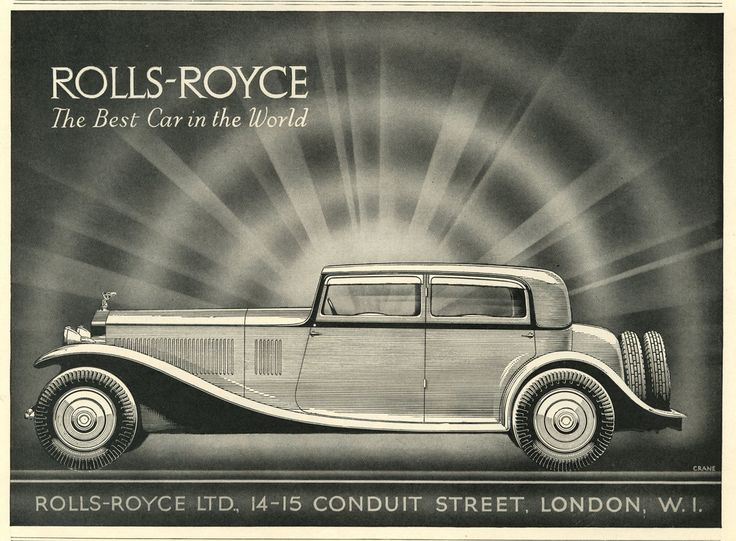
“I read this essay in college about American patriotism,” Zane says. “I don’t remember the author or title. But I do remember one point the author made. The author compares living in America to paying ten million [presumably US] dollars for a Rolls-Royce. You may have paid way too much, but, come on—you now own a freakin’ Rolls-Royce, man!”
Nine-point-four-second pause.
“Do they make electric Rolls-Royces now?” Luisa asks.
“Yes they do,” Cassie answers.
“Good. Then the environment might not deteriorate at such a rapid pace.”
“It’ll deteriorate at a nice leisurely pace,” Zane says.